


Description
Hybond 512-10-41 Manual Ball Bonder No Scope 110V EFO Semiconductor Wire Bond
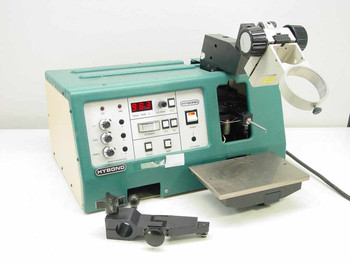
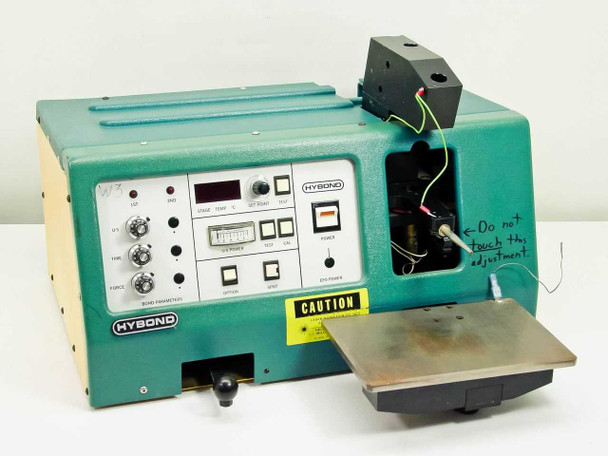
The Hybond 512-10-41 is a benchtop manual thermosonic ball bonder built by Hybond, Inc. of Escondido, California. It uses an Electronic Flame-Off (EFO) system to form a gold or aluminum wire ball, then bonds it to a semiconductor die or substrate using ultrasonic energy, heat, and controlled force. This unit is configured without a microscope (no scope), intended for use with a separately sourced optics setup.
Specifications & What's Included
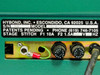
- Manufacturer: Hybond, Inc., Escondido, CA 92025 USA
- Model: 512-10-41
- Bonding method: Thermosonic ball bonding with EFO (Electronic Flame-Off)
- Microscope/scope: Not included (No Scope configuration)
- Power: 110V AC, 60Hz
- Fuse 1 (Stage): F1 10A
- Fuse 2 (Stitch): F2 1.5A
- Bond parameters: 1st bond / 2nd bond selectable; U/S Power (slider), Time, and Force — all adjustable via front-panel rotary controls
- Stage heating: Yes — digital Stage Temp °C display with Set Point adjustment
- Front panel controls: OPTION, SPOT, POWER, EFO POWER buttons; TEST and CAL functions
- Form factor: Benchtop
- Rear connectors: Multi-pin DIN connector, colored signal connectors, dual fuse holders (F1/F2)
- Power cord: Standard NEMA 5-15 included
- Note: One plastic SPOT button on control panel has a chip but remains functional (see photos)
Applications
Manual ball bonders like the Hybond 512-10-41 are used in semiconductor packaging and microelectronics assembly to form wire interconnects between a die and a leadframe, substrate, or PCB. The thermosonic process combines heat from a controlled stage, ultrasonic energy from the bond head transducer, and mechanical force to form reliable bonds — typically with 25–50 µm gold wire. Hybond was a well-regarded American manufacturer of wire bonding equipment from the 1970s through the 1990s, producing manual and semi-automatic machines widely used in R&D labs, prototype assembly, hybrid microcircuit manufacturing, and small-volume production. The 512-series bonders were a staple in university research labs, aerospace contractors, and electronics manufacturers working with IC packages, thick-film hybrids, and optoelectronic devices. Manual bonders remain in active use today in low-volume and prototype environments where the per-unit throughput of an automatic bonder is not required, and they are commonly sought for lab and repair use.
This Hybond 512-10-41 Manual Ball Bonder has been inspected and is in good used condition overall. The power specs are confirmed: 110V, 60Hz, F1 10A, F2 1.5A. One plastic button — the SPOT button on the control panel — has a chip on it, but it remains fully functional. The chassis shows typical wear consistent with lab use. Please review our full photo set for a detailed look at the unit's condition, and contact us if you have any questions.
Warranty Information
Additional Information
Brand: |
Hybond |
Model: |
512-10-41 |
MPN: |
512-10-41 |
Type: |
Manual Ball Bonder |
SKU: |
41384 |
Voltage: |
110V |
Frequency: |
60 Hz |
Fuse 1 (Stage): |
F1 10A |
Fuse 2 (Stitch): |
F2 1.5A |
Power Requirements: |
110V AC, 60Hz |
Bonding Method: |
Thermosonic Ball Bonding |
EFO (Electronic Flame-Off): |
Yes |
Microscope / Scope Included: |
No (No Scope) |
Bond Parameters: |
1st/2nd bond, U/S power, Time, Force — front panel |
Stage Heating: |
Yes — Stage Temp °C digital display with set point |
Country/Region of Manufacture: |
United States |
Manufacturer Location: |
Hybond, Inc., Escondido, CA 92025 USA |
Form Factor: |
Benchtop |
Application: |
Semiconductor wire bonding, IC packaging, die attach |
Seller Notes: |
Bonder only — no microscope. Power cord included. |
Condition Notes: |
This Hybond 512-10-41 Manual Ball Bonder is in good used condition. The SPOT button on the control panel is chipped but functional. 110V 60Hz, F1 10A, F2 1.5A. Please view photos and contact us with questions. |
California Prop 65 Warning: |
WARNING: This product can expose you to chemicals including lead and lead compounds, and DEHP (a phthalate), which are known to the State of California to cause cancer and birth defects or other reproductive harm. Go to P65Warnings.ca.gov |